Who was Benjamin Franklin?
Benjamin Franklin was one of the leaders of the American Revolution and Founding Fathers of the United States, helped draft the Declaration of Independence and was one of its signers. Franklin was a man of many talents and among others he was a printer, journalist, publisher, author, philanthropist, abolitionist, public servant, scientist, librarian, diplomat, and inventor. What Did Benjamin Franklin Invent?Benjamin Franklin made important contributions in many fields. His scientific achievements in science and invention include the Franklin stove, bifocals, medical catheter, swim fins, library chair, the odometer, glass armonica and more (a few of this devices he only improved or came up with his own version). In electricity he invented the lightning rod, discovered the principle of conservation of charge and identified positive and negative electrical charges. But he’s best remembered for the Franklin’s kite experiment (see below), and no wonder that sometimes he’s referred to as “Master of Electricity”. In literature and journalism he’s best known for writing, printing and publishing the famous Poor Richard's Almanac and The Pennsylvania Gazette. Franklin was also a diplomat and represented the United States in France during the American Revolution, and secured the French support that helped to make independence of the United States possible. He was also a civil servant and in 1775 Franklin became the first U.S. Postmaster General. Franklin's Kite ExperimentBen Franklin himself never wrote the story of the most dramatic of his experiments. All that is known about what he did on that famous day, of no known for sure date, comes from two resources: Joseph Priestley's account, published fifteen years afterwards in 1767 appears to be based on Franklin’s account himself through close and intense correspondence between them. (The History and Present State of Electricity, with original experiments, by Joseph Priestley, 1775 Vol. I pp 216-217)
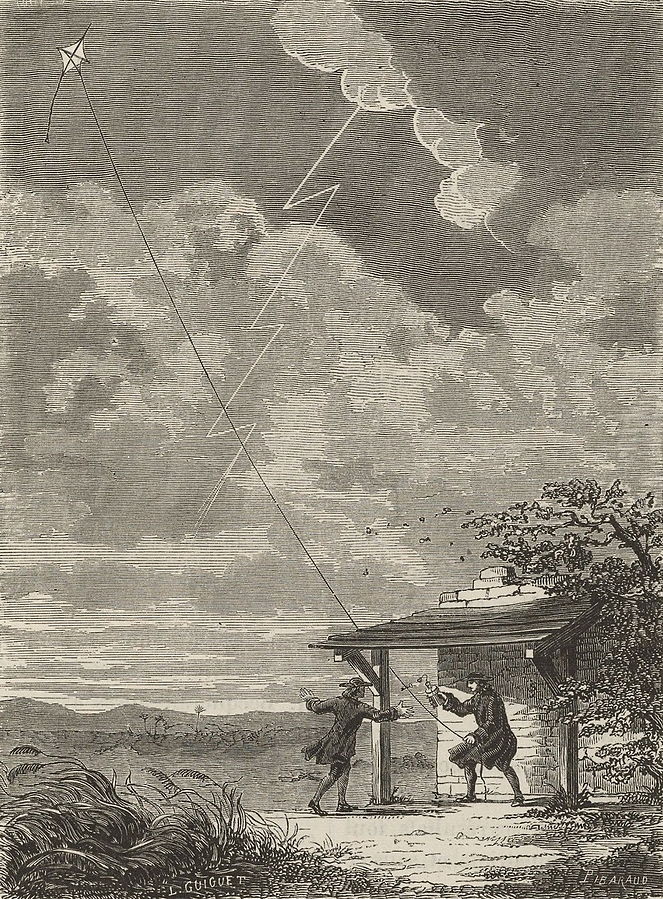
A letter in which Franklin described his kite experiment that was written in Philadelphia on October 1752 and was addressed to Peter Collinson, who had earlier provided Franklin with some simple apparatus for performing electrical experiments. A copy of the original letter is at present in the archives of the Royal Society in London. According to these sources, Franklin, on June 1752, built a kite with a sharp pointed wire attached to the kite to attract easier electrical charges (working like a lightning rod). He attached a key to the end of the kite string, near his holding hand, but held the kite with a silk ribbon also tied to the key for insulation security reasons. A thin metal wire, connected also to the key, was inserted into a Leyden jar, a container for storing electrical charges. Then, on a thunderstorm he let the kite fly. The kite was struck by lightning and cloud sparks (electrical charges / static electricity) flew through the wet kite and string to the key and inside the Leyden jar. After he noticed that loose fibers of the string were bristling outward because the string was charged with static electricity, he intentionally reached out his knuckle to touch the key and he felt an electrical shock. This experiment - the electrical shock to Franklin’s hand, the charged Leyden jar and the string's bristling fibers - proves beyond any doubt that lightning is an electric phenomenon. Many cast doubt at the possibility that Franklin really performed this experiment. For example, Tommy Tucker, a science writer, offers two reasons in particular for rejecting the kite story. One is that in describing the experiment in his newspaper, The Pennsylvania Gazette, Franklin does not say that he did it. The other is that the experiment as Franklin described it would be unlikely to succeed because of the design of the kite and the difficulty of flying it under the conditions outlined by Franklin.
On The other hand, others believe that Franklin indeed performed this experiment. Bernard Cohen, states that Franklin was in close contact with Priestley and therefore it is safe to assume that Priestley’s detailed report is based on Franklin himself.
Schiffer, professor of anthropology at the University of Arizona, accepts the tradition of the kite experiment, although he says it is "a long and inconclusive story." Others think that basically Franklin performed this experiment but with some required changes and not the way it is often described, namely, he did tie a key to the kite string, fly it in a thunderstorm, and wait for it to be struck by lightning - had he done so, most chances are that he wouldn’t survive it without to be killed. Evidence, from his writings, shows that he was aware of the dangers of electricity and to other possible safe alternatives to perform this dangerous experiment - among them, to draw sparks directly into the Leyden jar, from the key, without the need to touch it and as shown by his invention of the lightning rod using of the concept of electrical ground. It doesn’t really matter if Benjamin Franklin indeed performed the kite experiment in reality. What really matters is the question if this experiment (or maybe only a theoretical proposal) is founded on sound scientific principles and as a matter of fact it is a possible experiment that enables the conclusion that lightning is an electric phenomenon. Since we think that the answers to these questions are “yes” than we also think that Franklin should be fully credited with this experiment. There is some evidence that also Jacques de Romas, a Frenchmen, invented the famous kite experiment independently. Romas produced very long sparks in front of enthusiastic crowds in 1753. But regretfully only the name of Franklin is remembered. The Invention of the Lightning RodIn 1750, Benjamin Franklin published a proposal for an experiment to determine if lightning was electricity. He proposed extending a conductor into a cloud that appeared to have the potential to become a thunderstorm. If electricity existed in the cloud, the conductor could be used to extract it. Basically this experiment is the same as the one with the kite except the fact that the pointed conductor in the case of the kite is much higher and closer to the charged clouds. On May 10, 1752, Thomas-François Dalibard of France conducted Franklin's experiment using a 40-foot (12 m)-tall iron rod instead of a kite, and he extracted electrical sparks from a cloud. There is evidence that in the early 1750s Franklin himself tried the iron rod method for experimentation.
It is clear that Franklin's electrical experiments led to his invention of the lightning rod. He noted that conductors with a sharp rather than a smooth point were capable of discharging silently (like the case with the kite), and at a far greater distance. He surmised that this knowledge could be of use in protecting buildings from lightning, by attaching upright rods of iron, made sharp and gilt to prevent rusting, and from the foot of those rods a wire down to the outside of the Building into the Ground. Following a series of experiments on Franklin's own house, lightning rods were installed on the Academy of Philadelphia (later the University of Pennsylvania) and the Pennsylvania State House (later Independence Hall) in 1752. In the early 1750s, Franklin erected a lightning rod on top of his house for the purposes of experimentation, protection and, perhaps, to get electricity for experimentation without having to go through the laborious process of creating it himself via a primitive battery.
Franklin's "iron rod" drew lightning down into his house. The rod was connected to a bell and a second bell was connected to a grounded wire. Every time there was an electrical storm, the bells would ring and sparks would illuminate his house (see below). Basically, the kite experiment and the lightning rod are based on the same scientific principle that electric charges try to find their way in the shortest and easiest way to the ground. In the case of the kite experiment it was the wet kite and string, the key and Franklins body that grounded the clouds static electricity, and in the case of the lightning rod it is the sharp metallic rod. Follow in the Steps of Ben FranklinDon’t try to repeat the kite experiment or to erect lightning rods on building tops or elsewhere since those experiments are lethally dangerous. Warning: experiments with electricity should be performed under the supervision of teachers or adults familiar with electricity safety procedures. Especially, take in account that experiments with capacitors (Leyden jars) can produce lethal high voltage shocks dangerous to your health. Build a Leyden JarFranklin used Leyden jars in many of his experiments as seen above. Among others, he built, from a few Leyden jars connected in parallel, a primitive kind of battery. A Leyden jar is a primitive, first invented, capacitor where the dielectric is a glass jar or a plastic container and the metal plates are aluminum or metal foils coating the inside and outside of the jar or container; the container is closed by a foil coated cap. A wire or chain is connected to the inside coating and its free end is passed through the cap. The two electrodes of the Leyden jar are the outer foil coating and the wire or chain connected or touching the inside foil. Take in account that in order to get good results the Leyden jar must be grounded – put on any quite big metal surface. Wrinkles in the foil can be a major leakage source and is recommended to apply melted paraffin to the top of the both coatings for this end. You can charge your Leyden jar with an electrostatic generator, such as a Wimshurst machine or a Van de Graaf generator by connecting the machine’s two connectors to the Leyden jar’s electrodes. If you do not have an electrostatic machine you can also do it with an electrophorus or simply by rubbing fur. After your Leyden jar is charged you can discharge it and get sparks. The following links will help you in this effort: http://www.alaska.net...https://nationalmaglab.org... https://nationalmaglab.org... http://www.instructables.com... Build Your Benjamin Franklin Lightning BellsAs mentioned above, Franklin erected a lightning rod on top of his house. The rod was connected to a bell and a second bell was connected to a grounded wire and a clapper or ball was suspended between them from an insulated stand. Every time there was an electrical storm approaching, the bells would ring. This electrostatic device was invented in 1742 by Andrew Gordon, Professor of Natural Philosophy at the University at Erfurt, Germany. Franklin used Gordon’s idea in order to build his storm alarm. We are not going to connect our bells to any lightning roads since this is extremely dangerous. Instead we are going to use either a Wimshurst Static Electric Machine or a Van de Graaff generator or a TV set as our static electricity resource. How does this interesting device works? The lightning rod will charge the bell which is connected to it. Then this bell will attract the clapper because of rearrangement of electrical charges inside the clapper through charge induction. When the clapper hits the charged bell it will become charged to the same charge potential and therefore it will be repelled. Since the opposite bell is charged oppositely this will also attract the clapper towards it. When the ball touches the second bell its charge is transferred to the clapper and as a result the clapper is charged the same and is repelled again, and the process repeats. For more information: http://scitoys.com...http://www.rmcybernetics.com... http://www.history.org... http://www.arcsandsparks.com... Further ReadingLinksFranklin's Kite - Museum of Science, Boston (MOS) Franklin and His Electric Kite - The Electric Franklin Benjamin Franklin's Kite Experiment - codecheck.com Was Ben Franklin's Kite a Hoax? - hoaxes.org General Resources The Electric Franklin Benjamin Franklin: Glimpses of the Man - The Franklin Institute Benjamin Franklin: A Documentary History - J.A. Leo Lemay Benjamin Franklin - PBS The Autobiography of Benjamin Franklin - Archiving Early America Benjamin Franklin Biography - biography.com Books |
| Home | Fair Projects | Experiments |
| Scientists & Inventors | Science Jokes | Warning! |


webmaster@julianTrubin.com
