Definition
A fingerprint is an impression made by the pattern of lines on the tip of a human finger. These lines (ridges) are commonly believed to provide traction for grasping objects. Fingerprints afford an infallible means of personal identification, because the ridge arrangement on every finger of every human being is unique and does not alter with growth or age. A person's fingerprint can be used as a biometric method to identify human individuals.
Introduction
When a person touches something with his fingers, there will usually be a visible or invisible residue left on the touched surface. The residue is patterned as a copy of the person's fingerprint and can be collected for visual study and comparison. On the crime scene, in most of the cases, the prints are invisible and are called "latent fingerprints". Traditionally, finely ground powders of chalk or coal have been used to make the fingerprint clearly visible. The powder adheres to the fingerprint residue but not to the surrounding surface since "latent fingerprints" are nothing but fat and sweat on touched items. There are also chemical techniques such as cyanoacrylate fuming and ninhydrin spray that can help make fingerprints visible.
There are three basic fingerprint patterns: Arch, Loop and Whorl. There are more complex classification systems that further break down the pattern to plain arches or tented arches. Loops may be radial or ulnar. Whorls also have smaller classifications. However, the five most commonly used are: whorl, radial loop, ulnar loop, arch and tented arch.
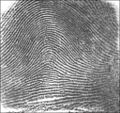
Arch
|
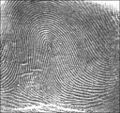
Right loop
|
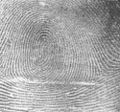
Whorl
|
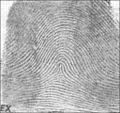
Tented arch
|
Fingerprinting Milestones
- Prehistory: A Picture of a hand with ridge patterns was discovered in Nova Scotia. In ancient Babylon, fingerprints were used on clay tablets for business transactions. In ancient China, thumb prints were found on clay seals.
- 1686: Marcello Malpighi, a professor of anatomy at the University of Bologna, noted in his treatise; ridges, spirals and loops in fingerprints. However, he made no mention of their value as a tool for individual identification.
- 1858: Sir William Herschel, Chief Magistrate of the Hooghly district in Jungipoor, India, was the first that used fingerprints. On a whim, Herschel had a local businessman, impress his hand print on a contract.
- 1880: Dr. Henry Faulds published his first paper on the subject in the scientific journal Nature in 1880. Returning to Britain in 1886, he offered the concept to the Metropolitan Police in London but was dismissed.
- 1883: Mark Twain In his book, "Life on the Mississippi", a murderer was identified by the use of fingerprint identification. In a later book by Mark Twain, "Pudd'n Head Wilson", there was a dramatic court trial on fingerprint identification.
- 1892: Sir Francis Galton published a detailed statistical model of fingerprint analysis and identification and encouraged its use in forensic science in his book Finger Prints.
- 1892: Juan Vucetich, an Argentine police officer who had been studying Galton pattern types for a year, made the first criminal fingerprint identification. He successfully proved guilty Francisca Rojas, who had murdered her two sons, finding her bloody fingerprint in the crime scene.
- 1901: Sir Edward Henry devised the Henry Classification System used in England and Wales. The first fingerprinting bureau was founded in Scotland Yard.
- 1902: Dr. Henry P. DeForrest used fingerprinting in the New York Civil Service.
- 1903: The New York State Prison system began the first systematic use of fingerprints in U.S. for criminals.
- 1924: An act of congress established the Identification Division of the FBI. The National Bureau of Criminal Identification and the US Justice Department's Bureau of Criminal Identification consolidated to form the nucleus of the FBI fingerprint files. The division's file contained the fingerprints of more than 250 million persons by the early 21st century. Fingerprint files and search techniques have been computerized to enable much quicker comparison and identification of particular prints.
|