Home Experiments Math Science Fair Projects Mathematics Jokes and Archimedes Mathematics Resources Mathematicians Warning!


Winding Number & Linking Number


Experiments Home
Mathematics
Winding Number & Linking Number


Mathematics Science Fair Projects Home

  • Statistics & Probability
  • Geometry & Trigo
  • Applied Mathematics
  • Number Theory
  • Learning & Cognition
  • Miscellany


  • Scientists and Inventors

    Scientists and Inventors


    Scientists and Inventors

    Scientists and Inventors
    This page is a compilation of two related articles:

    In mathematics, the winding number of closed curve in the plane around a given point is an integer representing the total number of times that curve travels counterclockwise around the point. The winding number depends on the orientation of the curve, and is negative if the curve travels around the point clockwise.

    In mathematics, the linking number is a numerical invariant that describes the linking of two closed curves in three-dimensional space. Intuitively, the linking number represents the number of times that each curve winds around the other. The linking number is always an integer, but may be positive or negative depending on the orientation of the two curves.

    Winding Number

    This curve has winding number two around the point p.
    This curve has winding number two around the point p.

    In mathematics, the winding number of closed curve in the plane around a given point is an integer representing the total number of times that curve travels counterclockwise around the point. The winding number depends on the orientation of the curve, and is negative if the curve travels around the point clockwise.

    Winding numbers are fundamental objects of study in algebraic topology, and they play an important role in vector calculus, complex analysis, geometric topology, differential geometry, and physics.

    Contents

    Intuitive description

    An object traveling along the red curve makes two full counterclockwise rotations around the person at the origin.
    An object traveling along the red curve makes two full counterclockwise rotations around the person at the origin.

    Suppose we are given a closed, oriented curve in the xy plane. We can imagine the curve as the path of motion of some object, with the orientation indicating the direction in which the object moves. Then the winding number of the curve is equal to the total number of counterclockwise rotations that the object makes around the origin.

    When counting the total number of rotations, counterclockwise motion counts as positive, while clockwise motion counts as negative. For example, if the object first circles the origin four times counterclockwise, and then circles the origin once clockwise, then the total winding number of the curve is three.

    Using this scheme, a curve that does not travel around origin at all has winding number zero, while a curve that travels clockwise around the origin has negative winding number. Therefore, the winding number of a curve may be any integer. The following pictures show curves with winding numbers between −2 and 3:

    \cdots               
    −2 −1 0
                   \cdots
    1 2 3

    Formal definition

    A curve in the xy plane can be defined by parametric equations:

    x = x(t)\quad\text{and}\quad y=y(t)\qquad\text{for }0 \leq t \leq 1.

    If we think of the parameter t as time, then these equations specify the motion of an object in the plane between t = 0 and t = 1. The path of this motion is a curve as long as the functions x(t) and y(t) are continuous. This curve is closed as long as the position of the object is the same at t = 0 and t = 1.

    We can define the winding number of such a curve using the polar coordinate system. Assuming the curve does not pass through the origin, we can rewrite the parametric equations in polar form:

    r = r(t)\quad\text{and}\quad \theta = \theta(t)\qquad\text{for }0 \leq t \leq 1.

    The functions r(t) and θ(t) are required to be continuous, with r > 0. Because the initial and final positions are the same, θ(0) and θ(1) must differ by an integer multiple of 2π. This integer is the winding number:

    \text{winding number} = \frac{\theta(1) - \theta(0)}{2\pi}

    This defines the winding number of a curve around the origin in the xy plane. By translating the coordinate system, we can extend this definition to include winding numbers around any point p.

    Alternate definitions

    Winding number is often defined in different ways in various parts of mathematics. All of the definitions below are equivalent to the one given above:

    Differential geometry

    In differential geometry, parametric equations are usually assumed to be differentiable (or at least piecewise differentiable). In this case, the polar coordinate θ is related to the rectangular coordinates x and y by the equation:

    d\theta = \frac{1}{r^2} \left( x\,dy - y\,dx \right)\quad\text{where }r^2 = x^2 + y^2.

    By the fundamental theorem of calculus, the total change in θ is equal to the integral of . We can therefore express the winding number of a differentiable curve as a line integral:

    \text{winding number} = \frac{1}{2\pi} \oint_C \,\frac{x}{r^2}\,dy - \frac{y}{r^2}
\,dx.

    The one-form (defined on the complement of the origin) is closed but not exact, and it generates the first De Rham cohomology group of the punctured plane. In particular, if ω is any differentiable one-form defined on the complement of the origin, then the integral of ω along closed loops gives a multiple of the winding number.

    Complex analysis

    In complex analysis, the winding number of a closed curve C in the complex plane can be expressed in terms of the complex coordinate z = x + iy. Specifically, if we write z = re, then

    dz = e^{i\theta} dr + ire^{i\theta} d\theta\!\,

    and therefore

    \frac{dz}{z} \;=\; \frac{dr}{r} + i\,d\theta \;=\; d[ \ln r ] + i\,d\theta.

    The total change in ln(r) is zero, and thus the integral of dz ⁄ z is equal to i multiplied by the total change in θ. Therefore:

    \text{winding number} = \frac{1}{2\pi i} \oint_C \frac{dz}{z}.

    More generally, the winding number of C around any complex number a is given by

    \frac{1}{2\pi i} \oint_C \frac{dz}{z - a}.

    This is a special case of the famous Cauchy integral formula. Winding numbers play a very important role throughout complex analysis (c.f. the statement of the residue theorem).

    Topology

    In topology, the winding number is an alternate term for the degree of a continuous mapping. In physics, winding numbers are frequently called topological quantum numbers. In both cases, the same concept applies.

    The above example of a curve winding around a point has a simple topological interpretation. The complement of a point in the plane is homotopy equivalent to the circle, such that maps from the circle to itself are really all that need to be considered. It can be shown that each such map can be continuously deformed to (is homotopic to) one of the standard maps S^1 \to S^1 : s \mapsto s^n, where multiplication in the circle is defined by identifying it with the complex unit circle. The set of homotopy classes of maps from a circle to a topological space is called the first homotopy group or fundamental group of that space. The fundamental group of the circle is the integers Z and the winding number of a complex curve is just its homotopy class.

    Maps from the 3-sphere to itself are also classified by an integer which is also called the winding number or sometimes Pontryagin index.

    Turning number

    One can also consider the winding number of the path with respect to the tangent of the path itself. As a path followed through time, this would be the winding number with respect to the origin of the velocity vector. In this case the example illustrated on the right has a winding number of 4 (or −4), because the small loop is counted.

    This is only defined for immersed paths (i.e., for differentiable paths with nowhere vanishing derivatives), and is the degree of the tangential Gauss map.

    This is called the turning number.

    Winding mumber and Heisenberg ferromagnet equations

    Finally here we would like to note that winding number closely related with the (2+1)-dimensional continuous Heisenberg ferromagnet equations and its integrable extensions: the Ishimori equation, the Myrzakulov equations and so on. Solutions of the last equations are classified by the winding number or topological charge (topological invariant and/or topological quantum number).

    See also

    External links

    Winding number on PlanetMath

    Linking Number

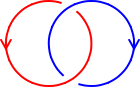
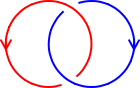
    The two curves of this (2,4)-torus link have linking number four.
    The two curves of this (2,4)-torus link have linking number four.

    In mathematics, the linking number is a numerical invariant that describes the linking of two closed curves in three-dimensional space. Intuitively, the linking number represents the number of times that each curve winds around the other. The linking number is always an integer, but may be positive or negative depending on the orientation of the two curves.

    The linking number was introduced by Gauss in the form of the linking integral. It is an important object of study in knot theory, algebraic topology, and differential geometry, and has numerous applications in mathematics and science, including quantum mechanics, electromagnetism, and the study of DNA supercoiling.

    Contents

    Definition

    Any two closed curves in space can be moved into exactly one of the following standard positions. This determines the linking number:

    \cdots
    linking number -2 linking number -1 linking number 0
    \cdots
    linking number 1 linking number 2 linking number 3

    Each curve may pass through itself during this motion, but the two curves must remain separated throughout.

    Computing the linking number

    With six positive crossings and two negative crossings, these curves have linking number two.
    With six positive crossings and two negative crossings, these curves have linking number two.

    There is an algorithm to compute the linking number of two curves from a link diagram. Label each crossing as positive or negative, according to the following rule[1]:

    The total number of positive crossings minus the total number of negative crossings is equal to twice the linking number. That is:

    \mbox{linking number}=\frac{n_1 + n_2 - n_3 - n_4}{2}

    where n1, n2, n3, n4 represent the number of crossings of each of the four types. The two sums n_1 + n_3\,\! and n_2 + n_4\,\! are always equal,[2] which leads to the following alternative formula

    \mbox{linking number}\,=\,n_1-n_4\,=\,n_2-n_3.

    Note that n1n4 involves only the undercrossings of the blue curve by the red, while n2n3 involves only the overcrossings.

    Properties and examples

    The two curves of the Whitehead link have linking number zero.
    The two curves of the Whitehead link have linking number zero.
    • Any two unlinked curves have linking number zero. However, two curves with linking number zero may still be linked (e.g. the Whitehead link).
    • Reversing the orientation of either of the curves negates the linking number, while reversing the orientation of both curves leaves it unchanged.
    • The linking number is chiral: taking the mirror image of link negates the linking number. Our convention for positive linking number is based on a right-hand rule.
    • The winding number of an oriented curve in the x-y plane is equal to its linking number with the z-axis (thinking of the z-axis as a closed curve in the 3-sphere).
    • More generally, if either of the curves is simple, then the first homology group of its complement is isomorphic to Z. In this case, the linking number is determined by the homology class of the other curve.
    • In physics, the linking number is an example of a topological quantum number. It is related to quantum entanglement.

    Gauss's integral definition

    Given two non-intersecting differentiable curves \gamma_1, \gamma_2 \colon S^1 \rightarrow \mathbb{R}^3, define the Gauss map Γ from the torus to the sphere by

    \Gamma(s,t) = \frac{\gamma_1(s) - \gamma_2(t)}{|\gamma_1(s) - \gamma_2(t)|}.

    The linking number of the two curves is equal to the degree of the Gauss map (i.e. the number of times that the image of Γ covers the sphere).

    We can use this definition to express the linking number of γ1 and γ2 as a double line integral:

    \mbox{linking number}\,=\,\frac{1}{4\pi}
\oint_{\gamma_1}\oint_{\gamma_2}
\frac{\mathbf{r}_1 - \mathbf{r}_2}{|\mathbf{r}_1 - \mathbf{r}_2|^3}
\cdot (d\mathbf{r}_1 \times d\mathbf{r}_2).

    This integral computes the total area of the image of the Gauss map (the integrand being the Jacobian of Γ) and then divides by the area of the sphere (which is 4π). It is known as the Gauss linking integral.

    Generalizations

    • Just as closed curves can be linked in three dimensions, any two closed manifolds of dimensions m and n may be linked in a Euclidean space of dimension m + n + 1. Any such link has an associated Gauss map, whose degree is a generalization of the linking number.
    • Any framed knot has a self-linking number obtained by computing the linking number of the knot C with a new curve obtained by slightly moving the points of C along the framing vectors. The self-linking number obtained by moving vertically (along the blackboard framing) is known as Kauffman's self-linking number.

    Notes

    1. ^ This is the same labeling used to compute the writhe of a knot, though in this case we only label crossings that involve both curves of the link.
    2. ^ This follows from the Jordan curve theorem if either curve is simple. For example, if the blue curve is simple, then n1 + n3 and n2 + n4 represent the number of times that the red curve crosses in and out of the region bounded by the blue curve.

    See also

    References


    This article is licensed under the GNU Free Documentation License. It uses material from Wikipedia Encyclopedia article "Winding Number"

    Scientists and Inventors    Scientists and Inventors    Scientists and Inventors   

    My Dog Kelly

    Site Map ♣ About Us ♣ Patent-Invent ♣ Free Theses, Dissertations & Patents

    Comments and inquiries could be addressed to:
    webmaster@julianTrubin.com


    Last updated: April 2008
    Copyright © 2003-2008 Julian Rubin