Home Experiments Physics Science Fair Projects Physics Jokes Physics Resources Physics Science Fair Project Books Warning!


Density of Various Materials
K-12 Experiments & Background information
For Science Labs, Lesson Plans, Class Activities & Science Fair Projects
For Middle School Students & Teachers


Experiments Home
Physics
Density


Physics Science Fair Projects Home

  • Mechanics
  • Force, Motion & Energy
  • Simple Machine Physics
  • Liquids
  • Gases
  • Air
  • Optics
  • Heat
  • Sound
  • Relativity & Black Holes
  • Nuclear Physics
  • Books


  • Offers 47 experiments of varied difficulty on topics ranging from buoyancy to simple machines.


    Science Fair Projects About the Properties of Matter: Using Marbles, Water, Ballons, and More


    Sports Science Projects: The Physics of Balls in Motion


    Forces and Motion Science Fair Projects: Using Water Balloons, Pulleys, and Other Stuff


    Science Fair Success Using Newton's Laws of Motion


    Light, Sound, and Waves Science Fair Projects: Using Sunglasses, Guitars, Cds, and Other Stuff


    Janice VanCleave's Magnets: Mind-boggling Experiments You Can Turn Into Science Fair Projects


    This experiment is courtesy of 

    Get Down With Density


    Developers:

    Barbara Allen
    Beeber Middle School
    Philadelphia School District

    Denis Dollard
    Analytical Research
    Rohm and Haas Company
    Bristol, PA


    Grade
    Level:

    6 and 7


    Objectives:

    1. Students will be able to define density.

    2. Students will observe that things that are less dense than water will float.

    3. Students will be able to find the density of copper, iron and aluminum.


    Vocabulary:

    DENSITY = the mass per unit volume of a substance.

    MASS = the amount of matter in an object.

    VOLUME = the amount of space something takes up.

    ELEMENT = a simple substance that cannot be broken down into simpler substances.


    Background:

    Density is a basic physical property of all matter. Every substance has a density that can be measured and the density of a substance is always the same. If you were asked, which do you think is heavier, a kilogram of feathers or a kilogram of lead, your initial response would probably be the lead. Surprisingly, they both weigh the same amount. How is this possible? A kilogram of feathers takes up a large amount of space, or volume. A kilogram of lead is small enough to hold in your hand. The kilogram of lead takes up less space because lead has a much greater density than the feathers. Density is the mass per unit volume of a substance. To find the density of a substance divide the mass by the volume.

    Density = 

    Mass
    _______

    Volume

    The amount of matter in an object is its mass. Consider the matter in a bag of potatoes to that of a bag of popcorn. The bag of potatoes has more matter than the bag of popcorn. The bag of potatoes has more mass. Mass is measured with an instrument called a balance, in units of grams. The amount of space an object takes up is called its volume. A graduated cylinder is used to measure the volume of a liquid and is often measured in milliliters. The volume of a solid can be determined by measuring the amount of water the solid displaces in a graduated cylinder.


    Lesson:

    Materials:

    Density of Metals

    iron cylinder (Fe - #26)
    aluminum cylinder (Al - #13)
    water (H
    20)
    unknown sample (brass)
    copper cylinder (Cu - #29)
    triple beam balance
    50-ml graduated cylinder


    Procedure:

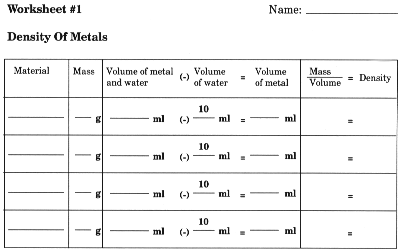
    1. Weigh the three samples on a triple beam balance, to find the mass.
    2. Record your answers on the worksheet.
    3. Fill a 25-ml graduated cylinder with 10 ml of water.
    4. Tilt the graduated cylinder slightly and place one sample in the graduated cylinder. Allow the sample to slide down the side of the cylinder. Try to avoid any water splashing or spillage.
    5. Record the volume of the water in the cylinder with the metal in it on the worksheet.
    6. Subtract the volume of the water from the volume of the metal and water, to get the volume of the metal.
    7. Remove water and sample from cylinder.
    8. Repeat steps 3-7 for the two remaining samples.
    9. Calculate the density of the metals examined on the worksheet.


    Questions:

    1. Which metal is the most dense?
    2. Which metal is the least dense?
    3. The density of water is 1 gram per milliliter. If ice floats on water, predict what you would think the density of an ice cube in a glass of water would be.


    Explanation:

    The density of water is 1 gram per milliliter. The metals used in this experiment have a density greater than 1 g/ml, therefore all the metals sink in water.


    Follow-Up Activities:

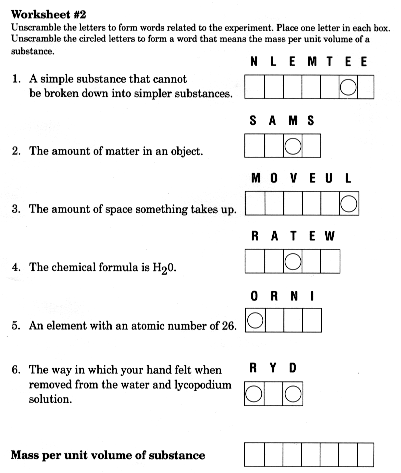
    Worksheet #2


    References:

    Bernstein, L., Schachter, M., Winkler, A., & Wolfe, S. (1991 ) Concepts and Challenges in Physical Science, Globe Book Company. Englewood Cliffs. New Jersey.

    Kellerman, Elizabeth R., Simple Chemistry, Grosset and Dunlap Publishers, New York: 1966.

    Palder, Edward L., Magic With Chemistry, Milliken Publishing Co., St. Louis, Missouri: 1984.

    Weast, R.C., CRC Handbook of Chemistry and Physics, 62nd Edition, CRC Press, Inc., Boca Raton, Florida: 1982


    Worksheets:


    This experiment is courtesy of 

    My Dog Kelly

    Site Map ♣ About Us ♣ Patent-Invent ♣ Free Theses, Dissertations & Patents

    Comments and inquiries could be addressed to:
    webmaster@julianTrubin.com


    Last updated: August 2007
    Copyright © 2003-2007 Julian Rubin