Build a Galileo Thermometer
A Galileo thermometer, Galilean thermometer (named after Italian physicist Galileo Galilei), or thermoscope is a thermometer made of a sealed glass cylinder containing a clear liquid and a series of objects whose densities are designed to sink in sequence as the liquid is warmed and decreases in density.
Typical design
Suspended in the liquid are a number of weights. Commonly those weights are themselves sealed glass bulbs containing colored liquid for an attractive effect. As the liquid in the cylinder changes temperature its density
changes and those bulbs which are free to move, rise or fall to reach a
position where their density is either equal to that of the surrounding
liquid or where they are brought to a halt by other bulbs. If the bulbs
differ in density by a very small amount and are ordered such that the
least dense is at the top and most dense at the bottom, they can form a
temperature scale.
The temperature is typically read from an engraved metal disc on
each bulb. Usually a gap would separate the top bulbs from the bottom
bulbs and then the temperature would be between the tag readings on
either side of the gap. If a bulb is free-floating in the gap, then its
tag reading would be closest to the ambient temperature. To achieve
this requires manufacturing the weights to a tolerance of less than
1/1000 of a gram (1 milligram).[1][2][3]
Theory of operation
The Galileo thermometer works due to the principle of buoyancy. Buoyancy determines whether objects float or sink in a liquid, and is responsible for the fact that even boats made of steel
can float (of course, a solid bar of steel by itself will sink). The
only factor that determines whether a large object will float or sink
in a particular liquid relates the object's density to the density of
the liquid in which it is placed. Small objects, such as a pin, can float through surface tension.
If the object's mass is greater than the mass of liquid displaced, the
object will sink. If the object's mass is less than the mass of liquid
displaced, the object will float.
Figure 1
Suppose there are two objects, each a cube 10 cm by 10 cm by 10 cm
(i.e., 1 liter). The mass of water displaced by an object of this size
is 1 kg. The brown object on the left is floating because the mass of
water it is displacing (0.5 kg) is equal to the mass of the object. The
green object on the right has sunk because the mass of water it is
displacing (1 kg) is less than the object's mass (2 kg).
Figure 2
Not all objects made of the green material above will sink. In
Figure 2, the interior of the green object has been hollowed out. The
total mass of the object is now 0.5 kg, yet its volume remains the
same, so it floats half way out of the water like the brown object in
Figure 1.
In the examples above, the liquid in which the objects have been
floating is assumed to be water. Water has a density of 1 kg/L, which
means that the mass of water displaced by any of the above objects when
fully submerged, is 1 kg.
Galileo discovered that the density of a liquid is a function of its temperature [1]. This is the key to how the Galileo thermometer works. (As the temperature of water increases or decreases from 4oC, its density decreases.) [2]
Figure 3
Figure 3 shows a 1 kg hollow object made of the green material. In
the left hand container, the density of the liquid is 1.001 kg/L. Since
the object weighs less than the mass of water it displaces, it floats.
In the right hand container, the density of the liquid is 0.999 kg/L.
Since the object weighs more than the mass of water it displaces, it
sinks. This shows that very small changes in the density of the liquid
can easily cause an almost-floating object to sink.
In the Galileo thermometer, the small glass bulbs are partly filled
with a different (coloured) liquid. Once the handblown bulbs have been
sealed, their effective densities are adjusted by means of the metal
tags hanging from beneath them. Even though these bulbs expand and
contract with changing temperatures, the effect on their density is
negligible. The heating and cooling of the coloured liquid and air gap
inside the bulbs will not greatly affect their density. The clear
liquid in which the bulbs are submerged is not water, but some inert hydrocarbon
(probably chosen because its density varies with temperature more than
water does). This change of density of the clear liquid, with
temperature change, causes the bulbs to rise or sink.
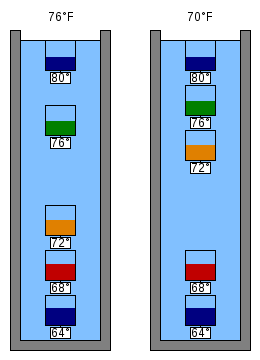
Figure 4
Figure 4 shows a schematic representation of a Galileo thermometer
at two different temperatures (the temperature markings on this example
are in Fahrenheit).
If there are some bulbs at the top (Figure 4, left) and some at the
bottom, but one floating in the gap, then the one floating in the gap
(green 76o) tells the temperature. If there is no bulb in
the gap (Figure 4, right) then you take the temperature of the bulb at
the bottom of the gap, add it to the temperature at the bulb at the top
of the gap, and divide the result by two. This will give you an
approximate measurement.
The bulbs and weights should be sized so as not to jam with each
other, either by being only somewhat less than the tube diameter to
retain their stacking order or, as an alternative, much less than the
tube diameter to freely pass each in the tube.
Notes
This article is licensed under the GNU Free Documentation License. It uses material from Wikipedia Encyclopedia article "Galileo Thermometer"
|