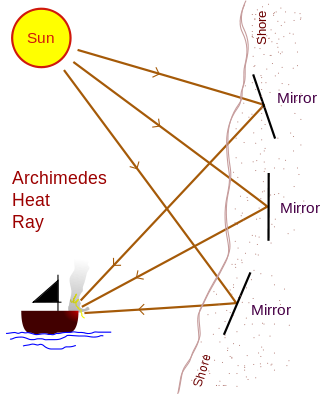
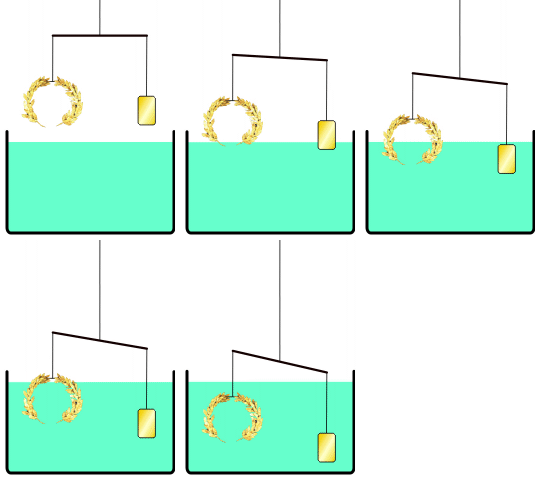
Archimedes was born in Syracuse, Sicily. He lived there most of his life. When the Romans attacked Syracuse, Archimedes invented weapons to defend the city. He is said to have suggested a method of employing mirrors to set enemy ships afire. After a two-year siege the Romans finally entered the city, and Archimedes was killed in the battle that followed. Among his other important inventions: the lever, the compound pulley and Archimedes’ screw. But his greatest fame lies in the field of mathematics. Archimedes was able to apply the method of exhaustion, which is the early form of integration, by which he calculated different areas and volumes of geometric shapes and solids. Archimedes also gave an accurate approximation to Pi and showed that he could approximate square roots accurately. He invented a system for expressing large numbers. In mechanics Archimedes discovered fundamental theorems concerning the centre of gravity of plane figures and solids. His most famous theorem gives the weight of a body immersed in a liquid, called after him, Archimedes' principle - that a body immersed in a fluid is subject to an upward force (buoyancy) equal in magnitude to the weight of fluid it displaces. Legend says that Archimedes discovered the principle of displacement while stepping into a full bath. He realized that the water that ran over equaled in volume the submerged part of his body. Through further experiments, he deduced the above mentioned Archimedes' principle. The legends goes further and tells that Archimedes was so excited with his discovery that he hopped out of the bath, and rushed naked into the street yelling triumphantly, "Eureka!" "Eureka!" (Greek word for 'I have found it!). Another legend describes how Archimedes uncovered a fraud against King Hieron II of Syracuse using his principle of buoyancy. The king suspected that a solid gold crown he ordered was partly made of silver. Archimedes took two pieces of pure gold and of pure silver that had weights identical to the weight of the crown. He then successively immerses the gold, the silver, and the crown in a container filled to the brim with water and measured the volume of water that overflowed with each material. He found that the crown displaced more water than the gold but less than the silver, thereby proving that the crown contained some other metal which was less dense than gold.
The experiment goes as follows: Stage a: Suspend objects of various sizes and masses from a spring scale. Note the reading of the scale in air for each object. Note the level of the water in the beaker. Stage b: Lower the objects into the beaker, record for each object the new reading on the spring scale and the new level of the water in the beaker. Stage c: Calculate the weight of water displaced by the object. Devise a rule relating the change in the reading of the scale and the weight of the displaced water. More about this subject: Verification of Archimedes' Principle - Online Labs Buoyancy Basics - PBS Density and Archimedes Principle - PhysicsLabs Grandpa Pencil Discovers Archimedes' Principle Buoyancy: Archimedes Principle - NASA Why do Helium Filled Balloons Rise? - Yerkes Winter Institute Newton’s Laws and Archimedes’s Principle - LPC Physics Archimedes Principle - Donald E. Simanek Can I Make Lead Float? - California State Science Fair How Fish Achieve Neutral Buoyancy - California State Science Fair Heavy Things Sink, Right? Not Always! - Michael Fenton Buoyancy - Hyperphysics Submarines: How They Work - explainthatstuff.com Fluid Physics Experiments - Rice University Liquid Science Fair Projects and Experiments Some links of interest about Archimedes: Archimedes and the Computation of Pi - Peter Alfeld's Home Page Infinite Secrets - PBS Archimedes and his Burning Mirrors - Michael Lahanas Completing Book II of Archimedes’s On Floating Bodies - Chris Rorres Bending Spacetime in the Basement - John Walker Archimedes biographies and general resource: Archimedes of Syracuse - MacTutor Archimedes Home Page - Drexel University Archimedes - crystalinks.com Archimedes - Bert G. Wachsmuth, Seton Hall University |
| Home | Fair Projects | Experiments |
| Scientists & Inventors | Science Jokes | Warning! |


webmaster@julianTrubin.com
