The Discovery of DNA
In 1869, Friedrich Miescher, a Swiss physician, isolated a substance from cell nuclei, that he called nuclein - now known as DNA. During the early years of the 20th century, cellular studies using ordinary light microscopes clarified the behavior of chromosomes during mitosis and meiosis, which led to the conclusion that chromosomes are the carriers of genes – the basic units of heredity. The chromosomes of eukaryotes contain a variety of proteins in addition to DNA. Soon the question arose whether the nucleic acids (DNA) or proteins, or both together, are the carriers of the genetic information. Until the early 1950s most biologists were inclined to believe that the proteins were the chief carriers if heredity. Nucleic acids contain only four different unitary building blocks, but proteins are made up of 20 different amino acids. Proteins therefore appeared to have a greater diversity structure, and the diversity of the genes seemed first likely to rest on the diversity of the proteins. The Contribution of Frederick Griffith
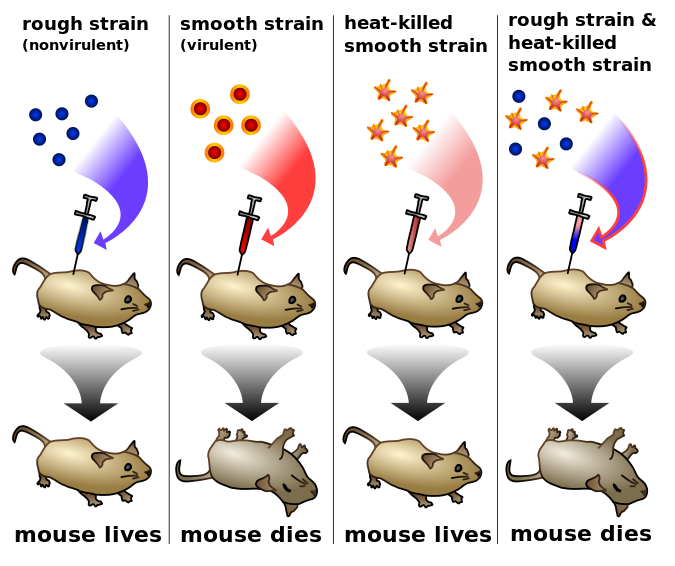
This experiment strongly implied that genetic material had been transferred from the dead to the live cell. It was hard to be certain of this, or to know what exactly genetic material was transferred and was responsible for the transformation process. DNA is the Transforming FactorThis Experiment strongly implied that DNA is the “transforming factor” and not proteins or other materials and by this was demonstrated what is known to us as the transforming principle - that genes are made of DNA. Amazingly, not everyone was convinced by the experiments of Avery's, MacLeod's and McCarty's. It was the experiments of Hershey and Chase (1952) that finally proved that DNA was the genetic material and not protein. While Avery and his team were nominated several times for the Nobel Prize, they never received it. It is a universally recognized omission of the Nobel committee since their work was a blazing discovery that changed everything. For more about this topic see in the link section "The Nobel Prize Omission" Repeat Avery, MacLeod and McCarty's ExperimentsAs a rule: this experiment should be performed under the supervision of professionals familiar with chemical, biomedical and laboratory safety procedures. Among others, it is not so simple to obtain some chemical or bio materials and supplies and use them properly and safely in these experiments. If you are a high school student do not try anything by yourself before you consult your teachers, parents or other knowledgeable adults and experts. Do not try to do this experiment, or any other activity related to it, alone! Notify your parents and school authorities before you begin - wait for their approval. A few laboratory biological safety links: http://www.who.int/csr... http://researchcompliance.uc.edu... After we have clarified the safety issue, a few useful remarks before you begin:
The detailed account of Avery, MacLeod and McCarty's Experiments could be found in their paper "Studies on the Chemical Nature of the Substance Inducing Transformation of Pneumococcal Types: Induction of Transformation by a Desoxyribonucleic Acid Fraction Isolated from Pneumococcus Type III", published in the February 1944 issue of the Journal of Experimental Medicine, in which Avery and his colleagues suggest that DNA, rather than protein as widely believed at the time, may be the hereditary material of bacteria and could be analogous to genes in higher organisms. A few links pointing to this article: http://www.twiv.tv... https://www.leeds.ac.uk... http://www.ncbi.nlm.nih.gov... Surf the web further and consult scientific libraries, databases and relevant experts, and if you are a high school student, consult also your teachers and other knowledgeable adults and professionals. Take in account that it's also possible to repeat other related experiments as well. For example: the mentioned above Hershey and Chase (1952). Further ReadingGenetics and Genomics Timeline:1944 - Genome News Network The Oswald T. Avery Collection - U.S. National Library of Medicine Avery, Macleod McCarty's Article from 1944 - MicroBiology Avery-MacLeod-McCarty experiment - Wikipedia Linus Pauling and the Race for DNA (searchable database) - Oregon State University The Chemical Nature of the Substance Inducing Transformation of Pneumococcal Types The Transforming Principal - Maclyn McCarty The Experiment That Transformed Biology - The Journal of Experimental Medicine Structures of DNA and RNA - Molecular Biology and Biochemistry How Can DNA be the Genetic Material? - Jeff Elhai The Nobel Prize Omission Maclyn McCarty Dies - The New York Times How Rhetorical Choices Can Influence the Impact of a Scientific Paper Prematurity in Scientific Discovery - Ernest B. Hook, Editor Science Fair Projects & Experiments DNA / RNA Science Fair Projects DNA Experiments DNA Identification Books


|
| Home | Fair Projects | Experiments |
| Scientists & Inventors | Science Jokes | Warning! |


webmaster@julianTrubin.com
