The Invention of Radio
In 1864, James Clerk Maxwell, a professor of experimental physics at Cambridge, proved mathematically that any electrical disturbance, that generates an electromagnetic field, could produce an effect at a considerable distance from the point at which it occurred and predicted that electromagnetic energy could travel outward from a source as waves moving at the speed of light. In 1888 Heinrich Hertz demonstrated that Maxwell’s prediction was true for transmission over a short distance. In 1901 the Italian physicist, Guglielmo Marconi, perfected a radio system that transmitted Morse code over the Atlantic Ocean. In 1906 the American physicist Lee De Forest invented the vacuum tube which amplified radio signals that were received by antenna, thus much weaker signal could be transmitted over longer distance. The vacuum tube was also used to generate radio waves and soon become the main component of radio transmitter. After World War II more advancements were made: The replacement of the vacuum tube by the transistor and of wires by printed circuits drastically reduced the power that radio equipment needed to operate enabling radio components miniaturization and more reliability. During the years claims were made that as a matter of fact not Marconi invented radio but Oliver Lodge, Alexander (Aleksandr) Popov or Nikola Tesla , had sent wireless messages before Marconi got his patents (British 7777, US 763,772). In 1943, in a celebrated 1943 Supreme Court decision, Marconi's 1904 US patent No. 763,772, was found to be invalid. As a result, some claim that this decision proves that Nikolai Tesla is the inventor of radio. It does not really matter. What Marconi undoubtedly did invent was an entirely new science-based industry. In his hands an obscure and, to most people, unintelligible branch of physics became a consumer product like no other. We are used to being told that some new technology will change the world. Marconi's is one of the few that did. For his scientific contribution Marconi was awarded the Nobel Prize in physics for the year 1909. Repeat Marconi's Radio Experiments
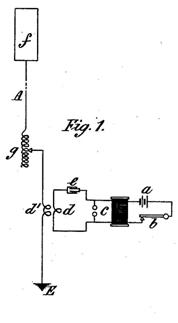
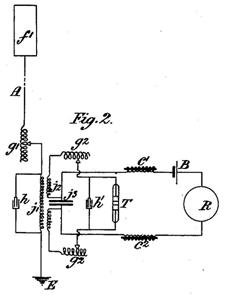
Marconi's experiment – creating, sending and detecting radio waves – is relatively simple, not beyond the abilities of high school students. In order to begin, read carefully the resources provided by this site and ensure that you understand the basic principals. Brows further the web and consult your local library, your teachers and other knowledgeable adults and experts. Marconi's transmitter (Fig 1) and receiver (Fig 2) are taken from the US, mentioned above, patent 763772 issued in 1904, and which was at the core of the litigation dispute of 1943. Before this patent, Marconi's radio equipment was limited by being essentially untuned, which greatly restricted the number of spark-gap radio transmitters which could operate simultaneously in a geographical area without causing mutually disruptive interference (like Heinrich Hertz spark gap transmitter). In this patent, Marconi addressed this defect with a much more sophisticated design, which featured two tuned-circuits at both the transmitting and receiving antennas. A good place to begin is to study Marconi's patent, which can be found in many places on the web. http://www.freepatentsonline.com... ResourcesBray, J. The Communications Miracle. New York: Plenum, 1995 Bussey, G. Marconi's Atlantic Leap. Coventry: Marconi Communications, 2001 Garratt, G. R. M. The Early History of Radio from Faraday to Marconi. London, IEE, 1993 Marconi, D. My Father, Marconi. Toronto: Guernica Editions Inc., 2nd edn, 1996 Marconi's Experiments Links: Article from "Experimental Science, G.M. Hopkins, 1902" - Frederick Collins Did Marconi Receive Transatlantic Radio Signals? (part 1) - Henry M. Bradford Did Marconi Receive Transatlantic Radio Signals? (part 2) - Henry M. Bradford A Look at Some of Marconi's Technology - R. Victor Jones Radio & Wireless Science Fair Projects and Experiments: Electronics Science Fair Projects and Circuits Invention of Radio History Links: Who Invented Radio? Marconi or Tesla? Marconi's Patent: 1900 - Sparkmuseum Misreading the Supreme Court: A Puzzling Chapter in the History of Radio - The Mercurians Who Invented Radio? History of Radio Tesla: Master of Lightning - PBS Invention of Radio Alexander Stepanovich Popov - Spektrum Alexander Stepanovich Popov - Mastertel Further Reading |
| Home | Fair Projects | Experiments |
| Scientists & Inventors | Science Jokes | Warning! |


webmaster@julianTrubin.com
